Tal Chhapar Blackbuck Relocation: Questions on Forest Department Decisions in Rajasthan
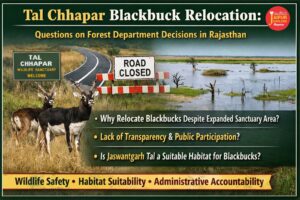
Tal Chhapar Blackbuck Relocation has recently sparked debate and concern among local communities, wildlife observers, and conservationists in Rajasthan. The ongoing process of shifting blackbucks (Krishna Mrig) from Tal Chhapar Sanctuary to Jaswantgarh Tal has raised critical questions about ecological planning, administrative decisions, and accountability.
This issue is not merely about wildlife movement—it reflects deeper concerns about habitat suitability, local participation, and conservation ethics.
Background of Tal Chhapar Sanctuary
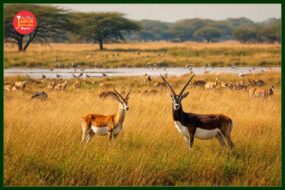
Tal Chhapar Sanctuary, located in Rajasthan’s Churu district, is widely known as a safe haven for blackbucks. This grassland ecosystem has supported a stable population of these elegant antelopes for years. The sanctuary is often described as the “lifeline” of the nearby Chhapar town.
In recent years, the Forest Department expanded the sanctuary area by taking over a 3-kilometer stretch of the Sujangarh–Chhapar road, previously under the Public Works Department (PWD). This move increased the sanctuary’s size, presumably to provide more space for wildlife conservation.
However, despite this expansion, blackbucks are now being relocated elsewhere—raising the first major concern.
Question 1: Why Relocate Blackbucks Despite Increased Sanctuary Area?
If the Tal Chhapar Sanctuary has already been expanded, why is there a need for Tal Chhapar Blackbuck Relocation?
The inclusion of the road area into the sanctuary was expected to benefit wildlife by increasing their habitat. Yet, instead of strengthening the local ecosystem, blackbucks are being forcibly moved to Jaswantgarh Tal.
This raises two key concerns:
- Contradictory Planning: Expanding habitat on one hand and reducing population density on the other seems inconsistent.
- Impact on Local Community: The road was a crucial lifeline for Chhapar residents. If it has been taken over for conservation, the benefits should remain within the sanctuary.
There is also a growing demand that if wildlife is being relocated, the road should be returned to the public for use.
Question 2: Lack of Transparency and Public Participation
Another major issue surrounding the Tal Chhapar Blackbuck Relocation is the lack of transparency.
Such a significant wildlife conservation effort could have been an opportunity to:
- Raise awareness
- Involve local communities
- Highlight conservation success
However, the relocation process was conducted without any formal ceremony or public engagement. No involvement was seen from:
- State leadership
- Forest Minister
- Local representatives
This absence raises doubts:
- Was the process intentionally kept low-profile?
- Were authorities avoiding public scrutiny?
Public participation is a key element in sustainable conservation, and its absence weakens trust in administrative decisions.
Question 3: Is Jaswantgarh Tal a Suitable Habitat?
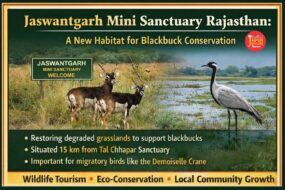
The most critical concern in the Tal Chhapar Blackbuck Relocation is the suitability of Jaswantgarh Tal as a habitat.
Wetland vs Grassland Conflict
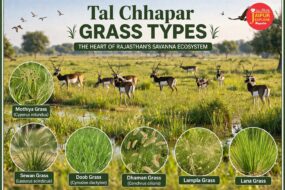
Blackbucks thrive in grassland ecosystems, where they can graze and run freely. However, Jaswantgarh Tal is primarily a wetland area, often waterlogged.
This mismatch raises serious ecological questions:
- How can a wetland support a grassland species?
- Was any scientific assessment conducted before relocation?
Reports suggest that earlier batches of relocated deer suffered fatalities due to unsuitable conditions. Instead of addressing the issue, new animals are reportedly being sent to maintain numbers.
This approach appears more like statistical adjustment than genuine conservation.
Concerns from Local Stakeholders
The relocation has faced opposition from:
- The Tapadia family (known for their contributions)
- Residents of Jaswantgarh and nearby villages
Despite these objections, the Forest Department proceeded with the plan. This raises concerns about:
- Ignoring local knowledge
- Lack of consultation
- Administrative rigidity
Local communities often have deep ecological understanding of their region. Overlooking their concerns can lead to flawed decisions.
Accountability and Ethical Questions
If blackbucks continue to suffer or die due to unsuitable conditions, a serious ethical and legal question arises:
Who is responsible?
Wildlife conservation is not just about numbers—it is about ensuring the safety, survival, and well-being of animals.
The Tal Chhapar Blackbuck Relocation brings forward issues such as:
- Administrative accountability
- Scientific validation of decisions
- Ethical responsibility toward wildlife
If negligence leads to animal deaths, should it not be treated as a serious violation?
The Need for Scientific and Transparent Conservation
The current situation highlights the urgent need for:
1. Scientific Evaluation
- Proper habitat analysis before relocation
- Expert ecological studies
2. Transparency
- Public disclosure of plans
- Inclusion of local stakeholders
3. Sustainable Planning
- Long-term conservation strategies
- Avoiding reactive decisions
4. Community Participation
- Engaging locals in decision-making
- Respecting ground-level knowledge
Final Thought
The Tal Chhapar Blackbuck Relocation is more than a wildlife management issue—it is a test of how conservation policies are implemented on the ground.
Relocating animals without ensuring suitable habitat, ignoring local concerns, and lacking transparency can undermine the very purpose of conservation.
Wildlife protection must be rooted in science, responsibility, and community involvement. Only then can such efforts truly succeed.