Jaipur Refinery Damage: What We Know So Far About CDU Loss and Financial Impact
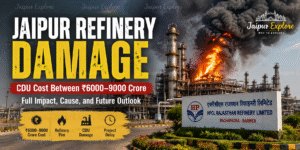
The Jaipur Refinery Damage has emerged as a major industrial concern after a recent incident raised serious questions about safety, financial risk, and project timelines. While authorities are still assessing the full extent of the damage, early estimates suggest that the refinery’s most critical component—the Crude Distillation Unit (CDU)—alone could cost between ₹6,000 crore and ₹9,000 crore.
This massive valuation highlights not only the scale of the project but also the potential economic setback if the damage turns out to be significant.
What Happened at the Rajasthan Refinery?
The incident occurred at the HPCL Rajasthan Refinery located in Pachpadra, near Barmer. Reports indicate that a fire broke out within the refinery complex, triggering immediate emergency responses and raising alarms about possible structural and operational damage.
Although the fire was brought under control, officials have clarified that the exact level of refinery damage is still unclear, and a detailed investigation is underway.
Experts believe that the situation could have been much worse if the fire had spread further into critical units like the CDU.
Why CDU Is the Most Critical Unit
The Crude Distillation Unit (CDU) is considered the “heart” of any refinery. It is the first stage where crude oil is processed and separated into various usable products such as petrol, diesel, kerosene, and other petrochemicals.
- It initiates the entire refining process
- It determines production capacity
- It directly impacts revenue generation
According to industry estimates, the CDU alone accounts for a significant portion of refinery investment, which explains why its cost ranges between ₹6,000 crore and ₹9,000 crore.
If this unit is damaged, it can halt operations completely, leading to prolonged shutdowns and financial losses.
Estimated Financial Impact of Jaipur Refinery Damage
The potential financial implications of the Jaipur Refinery Damage are enormous:
- CDU Replacement Cost: ₹6,000–₹9,000 crore
- Project Delay: Several months to nearly a year
- Revenue Loss: Delay in operations could result in significant missed earnings
Industry experts suggest that even a temporary shutdown of such a large refinery can lead to massive revenue losses due to halted production and delayed supply chains.
Given that the refinery is a multi-billion rupee project, any disruption can have ripple effects on the regional and national economy.
Cause of the Incident: What Experts Say
Initial findings indicate that the fire may have been triggered by a hydrocarbon leak, possibly from a valve or heat exchanger system.
Such leaks are highly dangerous in refinery environments because:
- Hydrocarbon gases are extremely flammable
- Even a small spark can cause a large-scale fire
- Containment becomes difficult once the fire spreads
However, authorities have not yet confirmed the exact cause, and multiple agencies are investigating the incident.
Was the Damage Prevented in Time?
In a positive development, officials managed to isolate key units, including the CDU and Vacuum Distillation Unit (VDU), preventing the fire from spreading further.
Experts believe that if the fire had reached the CDU, the damage could have exceeded ₹8,000 crore or more.
This timely intervention likely prevented a much larger industrial disaster.
Impact on Project Timeline
The refinery was nearing completion and expected to play a major role in India’s petrochemical sector. However, the incident may now delay its inauguration and full-scale operations.
- Repair work may take 3–4 months or more
- Full operational readiness could take up to a year
- Imported components may further delay restoration
Since many CDU components are sourced globally, replacement and installation are expected to be time-consuming.
Why This Incident Matters
The Jaipur Refinery Damage is not just a local issue—it has broader implications:
1. Economic Impact
Delays in refinery operations can affect fuel supply chains and industrial production.
2. Safety Concerns
The incident raises questions about industrial safety protocols and emergency preparedness.
3. Investment Risks
Large-scale infrastructure projects carry significant financial risks, especially when critical units are involved.
4. Policy Implications
The government has already ordered a probe, which could lead to stricter safety regulations.
Lessons for the Future
Industrial experts emphasize that incidents like these underline the need for:
- Advanced fire safety systems
- Regular technical audits
- Highly trained emergency response teams
- Strict compliance with safety protocols
Globally, refinery accidents have shown that preventive measures and quick response systems are crucial in minimizing damage.
Final Insights
The Jaipur Refinery Damage has brought attention to the vulnerabilities of large industrial projects, especially when critical components like the CDU are involved. While the full extent of the damage is still being evaluated, the estimated cost of ₹6,000–₹9,000 crore for the CDU alone highlights the scale of potential loss.
As investigations continue, the focus will remain on identifying the cause, assessing the damage, and ensuring that such incidents do not occur in the future. The coming months will be crucial in determining how quickly the refinery can recover and resume operations.
CDU cost India
crude distillation unit
HPCL refinery news
industrial fire Rajasthan
Jaipur refinery damage
oil refinery India
Pachpadra refinery
Rajasthan refinery fire
refinery accident India
refinery project delay