Narayan Singh Circle Traffic Jaipur Issue: Why Bus Stand Relocation Failed to Solve Congestion?
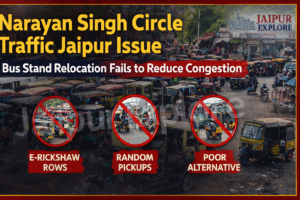
Narayan Singh Circle Traffic Jaipur Issue remains a major concern even after authorities shifted the bus stand to Transport Nagar in an effort to decongest one of Jaipur’s busiest intersections. Instead of solving the problem, the move appears to have only shifted and reshaped the congestion.
A year after the relocation, the situation at Narayan Singh Circle on Tonk Road continues to mirror the earlier chaos, raising serious questions about urban planning and traffic management strategies in Jaipur.
Background: Why Was the Bus Stand Shifted?
The decision to relocate the bus stand from Narayan Singh Circle was taken to:
- Reduce traffic congestion at a key junction
- Improve vehicular flow on Tonk Road
- Enhance road safety and reduce bottlenecks
The bus stand was officially shifted on April 1 last year to Transport Nagar, with alternative boarding points set up on Delhi Road and near Jawahar Nagar Circle.
The move was expected to bring long-term relief to commuters and streamline traffic movement.
Ground Reality: Congestion Still Persists
Despite these efforts, the Narayan Singh Circle Traffic Jaipur Issue remains unresolved.
1. Rise of Informal E-Rickshaw Stand
The most significant issue is the emergence of an unofficial e-rickshaw stand at the same location:
- E-rickshaws line up in rows
- Drivers wait until vehicles are fully occupied before moving
- The pattern closely resembles the earlier bus stand congestion
This informal setup has recreated the same traffic bottleneck the relocation aimed to eliminate.
2. Passenger Behavior Has Not Changed
Another major factor is commuter habits:
- Passengers still prefer boarding from the old location
- Many avoid going to Transport Nagar due to inconvenience
- Autorickshaws and app-based bikes also stop frequently
This behavior has contributed to the persistence of congestion at the intersection.
3. Unregulated Transport Activities
Apart from e-rickshaws:
- Auto-rickshaws and private vehicles halt randomly
- No strict enforcement of no-stop rules
- Lack of designated pickup points
All these factors combine to slow down traffic flow significantly.
What Officials Say
Authorities have acknowledged the issue but indicate that enforcement gaps exist.
- Former traffic officials confirmed that proposals to formalize the e-rickshaw stand were rejected
- Current officials claim they are unaware of how the informal stand developed
- Action may be taken if it continues to worsen congestion
This reflects a lack of coordination and follow-through in traffic management.
Impact on Daily Commuters
For regular commuters, the Narayan Singh Circle Traffic Jaipur Issue is more than just an inconvenience:
- Increased travel time during peak hours
- Higher fuel consumption due to slow traffic
- Stress and unpredictability in daily commutes
One commuter noted that congestion is simply being shifted from one area to another instead of being resolved.
Problems with the Relocation Strategy
The failure of the relocation plan highlights several key issues:
1. Lack of Integrated Planning
Relocating a bus stand without addressing supporting infrastructure leads to incomplete solutions.
2. Poor Enforcement
Rules prohibiting stopping at the intersection are not being strictly implemented.
3. Ignoring Human Behavior
Authorities underestimated the importance of commuter convenience and habits.
4. Inadequate Alternative Facilities
Transport Nagar itself lacks proper amenities, discouraging passengers from using it effectively.
Ripple Effects Across Jaipur
The impact of this issue is not limited to one junction:
- Nearby areas like Govind Marg also face increased congestion
- Other intersections risk becoming informal transit points
- Traffic management resources are stretched thin
Jaipur’s growing population and vehicle numbers further complicate the situation.
Urban Planning Lessons
The Narayan Singh Circle Traffic Jaipur Issue offers important lessons for city planners:
- Infrastructure changes must be supported by proper facilities
- Public awareness campaigns are essential
- Behavioral patterns must be considered in planning
- Continuous monitoring and quick corrective action are necessary
Without these, even well-intended projects can fail.
What Needs to Be Done?
To address the issue effectively, authorities must take immediate steps:
1. Strict Enforcement
Remove illegal e-rickshaw stands and penalize violations.
2. Improve Transport Nagar Facilities
Ensure proper lighting, seating, and connectivity to attract passengers.
3. Designated Pickup Zones
Create clearly marked areas for autos and e-rickshaws.
4. Public Awareness Campaigns
Educate commuters about using designated boarding points.
Future Outlook
Jaipur is expanding rapidly, and efficient traffic management is critical for its growth. Projects like bus stand relocation must be implemented with a holistic approach, combining infrastructure, enforcement, and public cooperation.
If corrective measures are taken promptly, the situation at Narayan Singh Circle can still improve. Otherwise, it risks becoming a permanent example of flawed urban planning.
Final Thought
The Narayan Singh Circle Traffic Jaipur Issue clearly shows that relocation alone is not a solution to urban congestion. While the intention behind shifting the bus stand was valid, poor execution and lack of follow-up have resulted in the persistence of traffic chaos.
For Jaipur to move forward as a smart and well-planned city, authorities must learn from this experience and adopt a more comprehensive and people-centric approach to urban development.