AI Disruption Career Choices: A New Reality for Today’s Youth
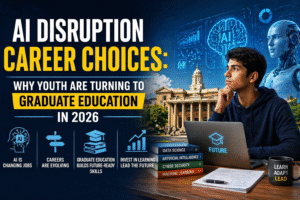
AI Disruption Career Choices are rapidly transforming how young people plan their futures. In 2026, students and fresh graduates are no longer following traditional career paths. Instead, they are rethinking their options due to the growing influence of artificial intelligence (AI) on jobs, industries, and employability.
Recent trends show that many young individuals are choosing to pursue graduate education instead of entering the workforce immediately. This shift is largely driven by concerns about job security, automation, and the uncertainty created by AI technologies.
Why AI Is Reshaping Career Decisions
Artificial intelligence is not just a technological advancement—it is a disruptive force redefining the global job market. From automation to smart algorithms, AI is replacing repetitive and entry-level tasks at an unprecedented pace.
1. Decline in Entry-Level Opportunities
One of the biggest impacts of AI disruption is the shrinking number of entry-level jobs. Many roles that once helped graduates gain experience are now being automated.
- Tasks like data entry, report generation, and basic analysis are increasingly handled by AI systems
- Fresh graduates are struggling to find their first job opportunities
- The traditional “start small and grow” career path is weakening
This situation creates a major challenge: without entry-level jobs, how do young professionals gain experience?
2. Fear of Job Instability
AI disruption is creating uncertainty about long-term career stability. Even roles considered secure a decade ago are now vulnerable to automation.
Experts warn that AI could impact millions of jobs globally, especially those involving repetitive or predictable tasks.
As a result, students are becoming more cautious and strategic in their career planning.
3. Changing Skill Requirements
The demand for skills is evolving rapidly. Employers now prioritize:
- AI literacy and digital skills
- Critical thinking and problem-solving
- Creativity and emotional intelligence
According to reports, AI is not only replacing jobs but also creating new ones that require advanced and specialized skills.
This shift is forcing students to rethink their education choices.
Why Graduate Education Is Becoming Popular
In response to AI Disruption Career Choices, graduate education is emerging as a preferred path among youth.
1. A Strategy for Future Security
Many students view higher education as a “safety net” against AI-driven job losses.
- Advanced degrees provide specialized knowledge
- They improve employability in competitive industries
- They offer better long-term career prospects
This trend is notable because it is happening even without an economic recession—unlike in the past.
2. Upskilling and Reskilling Opportunities
Graduate programs allow students to gain skills that are aligned with future job markets.
Popular fields include:
- Artificial Intelligence and Machine Learning
- Data Science and Analytics
- Cybersecurity
- Robotics and Automation
Universities are also updating their curriculum to include industry-relevant skills and real-world exposure.
3. Better Career Outcomes
Students are no longer choosing degrees blindly. Instead, they are evaluating:
- Return on investment (ROI)
- Placement opportunities
- Industry connections
- Internship exposure
Graduate education is now seen as a calculated investment, not just an academic milestone.
AI Anxiety: A Driving Force Behind Decisions
The term “AI anxiety” is becoming increasingly relevant. It reflects the fear among youth about:
- Losing jobs to automation
- Choosing the wrong career path
- Falling behind in a tech-driven world
This psychological factor is playing a major role in AI Disruption Career Choices, pushing students toward safer and more future-proof options.
The Shift from Traditional Career Paths
The conventional belief—study, graduate, get a job—is no longer reliable.
What’s Changing?
- Degrees alone are not enough
- Skills matter more than qualifications
- Continuous learning is essential
Industry leaders now emphasize adaptability over fixed career plans.
India’s Growing Role in the AI Economy
India is emerging as a global leader in AI adoption and innovation.
- AI market expected to grow significantly by 2032
- Increasing demand for AI-skilled professionals
- Government initiatives promoting AI education and research
This growth is encouraging students to align their careers with AI-driven industries.
Challenges of Graduate Education
While graduate education offers advantages, it also comes with challenges:
1. Financial Burden
- Higher tuition fees
- Student loans and debt
2. Uncertain Returns
- Not all degrees guarantee high-paying jobs
- Market demand may change rapidly
3. Time Investment
- Delayed entry into the workforce
Students must carefully evaluate these factors before making decisions.
How Students Can Adapt to AI Disruption
To navigate AI Disruption Career Choices, students should focus on:
1. Continuous Learning
Stay updated with new technologies and industry trends.
2. Skill-Based Education
Choose courses that offer practical and job-oriented skills.
3. Hybrid Skill Development
Combine technical skills with soft skills like communication and leadership.
4. Smart Career Planning
Evaluate long-term opportunities instead of short-term gains.
The Future of Careers in an AI World
AI is not just eliminating jobs—it is transforming them.
Emerging Opportunities
- AI development and research
- Human-AI collaboration roles
- Creative and strategic professions
The key is to adapt, not resist.
Conclusion
AI Disruption Career Choices are redefining how young people approach education and employment. With the rise of automation and changing job dynamics, graduate education is becoming a strategic choice rather than an optional step.
However, success in this new era depends on more than just degrees. It requires adaptability, continuous learning, and a forward-thinking mindset.
The future belongs to those who are prepared—not just educated.