Rajasthan Padyatra for Cow Protection Gains Momentum in Jaipur
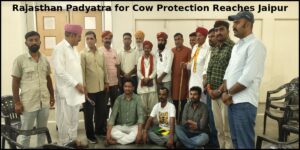
Jaipur, April 16: Rajasthan padyatra for cow protection has emerged as a powerful farmers’ movement, drawing statewide attention as participants reached Jaipur after a long and determined foot march. The padyatra, which began from the Mata Temple in Parbatsar (Nagaur district), aims to highlight the alarming decline in cattle population and its serious impact on the environment and rural livelihoods.
This is being described as one of the first organized padyatras in Rajasthan focused specifically on livestock preservation and ecological balance. Farmers, activists, and local residents joined the march, walking for days to ensure their voices reach the authorities.

Background of the Movement
The Rajasthan padyatra for cow protection started with a clear objective—to bring immediate attention to the growing crisis of declining cattle numbers. Farmers from Nagaur district, known for their dependence on livestock, initiated the march carrying essential items such as water, grains, and symbolic offerings.
Their journey to Jaipur was not merely a protest but a representation of rural distress. Participants from multiple districts joined along the route, turning the padyatra into a collective movement reflecting widespread concern across Rajasthan.
Sharp Decline in Cattle Population
One of the most pressing issues raised during the Rajasthan padyatra for cow protection is the drastic reduction in cow population. According to claims made by participants, Nagaur district alone has seen a decline of nearly 6 to 7 lakh cows in recent years.
This sharp drop has raised serious questions about livestock policies, grazing land availability, and the overall neglect of cattle welfare. Farmers argue that such a decline is not just an agricultural concern but a larger environmental crisis.
Cattle play a crucial role in organic farming by providing natural manure, which enhances soil fertility. Their absence forces farmers to rely on chemical fertilizers, increasing costs and harming the environment.
Environmental Impact of Declining Livestock
The Rajasthan padyatra for cow protection has also brought attention to the ecological consequences of reduced cattle numbers. Livestock are an essential part of the natural ecosystem, contributing to nutrient recycling and sustainable agriculture.
Experts suggest that the decline in cattle population can disrupt the balance between soil, crops, and natural resources. It may lead to reduced agricultural productivity, loss of biodiversity, and increased environmental degradation.
Participants in the padyatra emphasized that protecting cows is directly linked to protecting the environment. They called for immediate steps to restore ecological balance through better livestock management policies.
Farmers Demand Policy Reforms
As part of the Rajasthan padyatra for cow protection, farmers submitted a memorandum to the state government upon reaching Jaipur. Their demands include:
- Strong policies for cattle protection and welfare
- Development of proper infrastructure such as गौशालाएँ (cow shelters)
- Financial support for farmers managing livestock
- Measures to prevent illegal cattle trade
- Sustainable solutions for stray cattle issues
Despite submitting these demands, participants expressed disappointment over the lack of immediate response or concrete action from authorities.

Government Response Under Scrutiny
The Rajasthan padyatra for cow protection has put the government under pressure, as farmers continue to raise concerns over inaction. Protesters claim that although the issue has been discussed multiple times, no significant steps have been taken on the ground.
The absence of a clear policy framework and slow implementation have led to growing frustration among the farming community. Many believe that without urgent intervention, the crisis could worsen, affecting both agriculture and the rural economy.
Cultural and Religious Significance
Beyond environmental and economic concerns, the Rajasthan padyatra for cow protection also carries deep cultural and religious importance. In many parts of India, cows are considered sacred and hold a significant place in traditional practices.
Participants have announced plans to extend their journey to Ayodhya’s Ram Temple, where they intend to symbolically present their demands. This reflects the emotional and cultural connection people have with cattle, making the movement more than just a policy issue.
Possibility of Statewide Protest
Organizers of the Rajasthan padyatra for cow protection have warned that if their demands are not addressed soon, the movement could escalate into a larger protest. Plans for statewide demonstrations and awareness campaigns are already being discussed.
Such an escalation could draw national attention to the issue, putting further pressure on policymakers to act swiftly.
A Voice of Rural Rajasthan
The Rajasthan padyatra for cow protection represents the collective voice of rural communities who feel neglected in policy decisions. It highlights the gap between government promises and ground realities faced by farmers.
For many participants, this movement is about survival, sustainability, and preserving their way of life. It underscores the urgent need for inclusive policies that address both environmental concerns and farmers’ livelihoods.
Conclusion
The Rajasthan padyatra for cow protection is not just a march—it is a wake-up call. It brings into focus the interconnected challenges of declining cattle population, environmental degradation, and farmer distress.
If addressed effectively, this movement could lead to meaningful reforms in livestock management and sustainable agriculture. However, continued inaction may result in deeper crises affecting Rajasthan’s rural economy and ecological balance.
The coming days will be crucial in determining whether the government responds with concrete measures or whether the movement intensifies further.