Independent MLA Bhati Security Cover Reduced: Rajasthan Move Triggers Debate
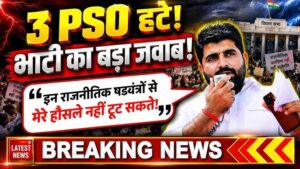
Independent MLA Bhati Security Cover Reduced has become a major political talking point in Rajasthan after the state government decided to withdraw additional security personnel assigned to Sheo MLA Ravindra Singh Bhati. The move, which leaves him with only one personal security officer (PSO), has sparked controversy and raised questions about security protocols and political motivations.
According to official sources, the decision was taken based on intelligence inputs and existing government policy, which allows only one PSO for legislators.
What Changed in Bhati’s Security Arrangement?
Earlier, Ravindra Singh Bhati was provided with enhanced security that included four personnel—one primary PSO and three additional security officers. However, under the latest order issued by the Barmer Superintendent of Police on April 13, three PSOs have been withdrawn, leaving him with just one gunman.
This change aligns with standard government rules stating that MLAs and MPs are generally entitled to a single PSO unless there is a specific threat perception.
Reasons Behind the Decision
Authorities have cited two main reasons for the Independent MLA Bhati Security Cover Reduced decision:
1. Intelligence-Based Assessment
Security cover is typically reviewed based on threat perception. Officials stated that updated intelligence inputs did not justify the continuation of additional security personnel.
2. Government Policy Compliance
The decision also follows a uniform policy ensuring that all legislators receive equal security provisions unless exceptional circumstances arise.
Political Timing Raises Questions
The timing of the Independent MLA Bhati Security Cover Reduced decision has added a political dimension to the issue. The reduction came shortly after Bhati participated in the Oran Bachao protest in Jaipur, where he voiced strong opposition to certain government policies.
Bhati has alleged that the move is politically motivated and described it as a “side effect” of his activism.
Political observers believe that such developments often lead to speculation, especially when security decisions coincide with public protests or dissent.
Background: Why Bhati Was Given Extra Security
Ravindra Singh Bhati had earlier been provided enhanced security during the 2024 Lok Sabha elections after reportedly receiving death threats.
His active involvement in issues such as:
- Oran (sacred grazing land) protection
- Solar project concerns
- Local governance and land disputes
has kept him in the political spotlight, sometimes attracting both support and opposition.
Concerns Over Safety and Public Perception
The Independent MLA Bhati Security Cover Reduced move has raised concerns among supporters and political analysts regarding the safety of public representatives.
Key concerns include:
- Whether the threat perception has genuinely reduced
- Risks associated with limiting security to a single officer
- Public confidence in security decision-making processes
Supporters argue that reducing protection for a vocal and active MLA could expose him to potential risks.
Administrative vs Political Narrative
The situation presents two contrasting narratives:
Administrative View
Authorities maintain that the decision is purely procedural and based on policy and intelligence inputs. They emphasize that all legislators are treated equally under security guidelines.
Political View
Bhati and his supporters see the move as a pressure tactic aimed at discouraging dissent and activism. The timing of the decision has fueled this perception.
This dual narrative has made the Independent MLA Bhati Security Cover Reduced case a subject of intense debate in Rajasthan politics.
Security Policy for Public Representatives in India
In India, security cover for politicians is categorized based on threat perception, including:
- Z+ category
- Z category
- Y category
- X category
However, most MLAs are typically assigned limited security unless there is a specific threat.
The Independent MLA Bhati Security Cover Reduced case highlights how security allocation is not just a safety issue but also a sensitive political matter.
What Happens Next?
As the controversy continues, several developments are expected:
- Possible review of Bhati’s threat perception
- Political reactions from opposition and ruling parties
- Continued public debate over security and governance
The case may also influence how future security decisions are perceived and communicated
Final Verdic
The Independent MLA Bhati Security Cover Reduced decision has gone beyond a routine administrative move and evolved into a politically charged issue. While authorities insist it is a policy-driven step, the timing and context have raised legitimate questions.
In a लोकतांत्रिक system, ensuring the safety of elected representatives while maintaining transparency in decision-making is crucial. This case serves as a reminder that security policies must not only be fair but also appear fair to maintain public trust.